
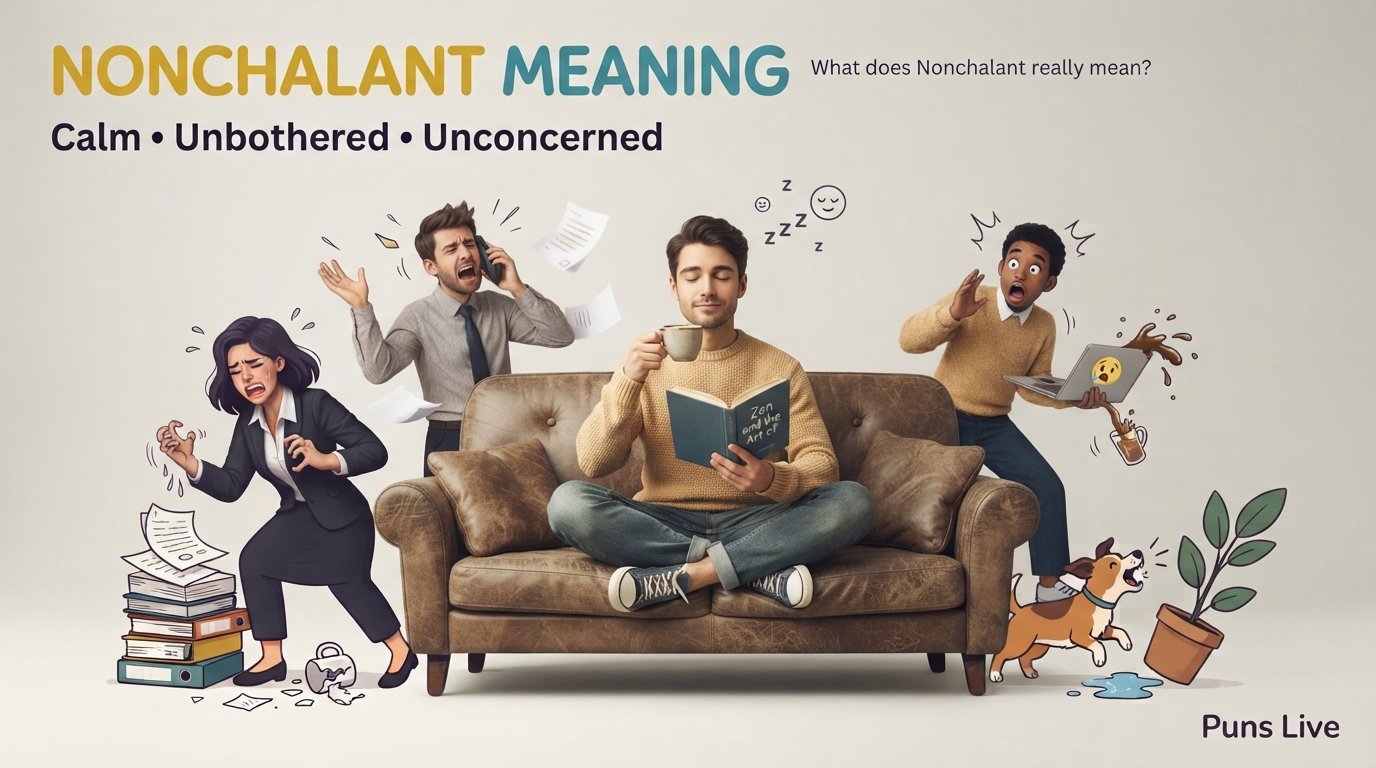

Someone can receive surprising news, face an awkward moment, or walk into a stressful situation and barely change their expression. That kind of calm and unaffected behavior is often described as nonchalant. But does being nonchalant mean someone genuinely does not care? Not always. The word usually describes how a person appears on the outside, while their real feelings may be very different.
What Nonchalant Actually Means
Nonchalant is an adjective used to describe someone who appears calm, relaxed, and unconcerned, especially when a stronger emotional reaction might normally be expected.
In simple English, if someone stays unusually relaxed when everyone else is nervous, excited, surprised, or upset, you might describe their behavior as nonchalant.
| Element | Meaning |
|---|---|
| Word | Nonchalant |
| Part of speech | Adjective |
| Core idea | Calm, relaxed, or seemingly unconcerned |
| Positive use | Calm, confident, composed |
| Negative use | Indifferent, dismissive, or careless |
| Common settings | Conversation, texting, relationships, work, and social media |
The important idea is that nonchalant describes an appearance or manner. It does not prove that someone feels nothing. A person may be nervous inside while appearing completely calm on the outside.
For example, imagine someone is about to give an important presentation. Everyone around them is panicking, but they calmly arrange their notes and say that everything will be fine. Their relaxed manner could be described as nonchalant.
The Simple Meaning of Nonchalant
Nonchalant means appearing calm and unconcerned, particularly when other people might expect more emotion or concern.
It can describe a persons general manner, a temporary reaction, or the way someone responds to a particular situation.
What the Word Suggests About Someone’s Behavior
A nonchalant attitude may involve little visible excitement, relaxed body language, short responses, or an unusually calm reaction.
The word focuses on observable behavior rather than someones private thoughts. That distinction matters because people do not always express emotions openly.
Does Nonchalant Mean Someone Does Not Care?
Not necessarily.
Someone who looks nonchalant may care deeply but choose not to show it. They might be naturally reserved, confident under pressure, uncomfortable expressing emotion, or simply trying to stay composed.
For this reason, nonchalant and uncaring are not exact synonyms.
How a Nonchalant Person Usually Acts
There is no single behavior that makes someone nonchalant. The impression usually comes from how their reaction compares with the situation.
Staying Calm When Others React Strongly
Suppose a group hears unexpected news and everyone starts asking questions while one person simply nods and says okay. That person may appear nonchalant because their reaction is much calmer than everyone elses.
Giving Short or Casual Responses
A person may seem nonchalant when they respond to something important with very few words.
For example:
I finally got the job.
Nice.
Depending on the situation, that short response could sound relaxed, uninterested, or simply emotionally restrained.
Looking Unbothered in Emotional Situations
Nonchalant behavior can look like someone is unaffected by criticism, awkwardness, unexpected news, or a tense conversation.
However, appearance does not always reveal emotion. Someone can feel uncomfortable or upset without showing it.
Acting Relaxed Even Under Pressure
A person who remains composed during an interview, deadline, presentation, or unexpected problem may be described positively as nonchalant.
In this context, the word can suggest confidence rather than indifference.
Why Nonchalant Can Mean Different Things
The meaning of nonchalant changes subtly with context, tone, relationship, and situation.
| Situation | What nonchalant may suggest |
|---|---|
| Stressful event | Calm and composed |
| Unexpected news | Unfazed or relaxed |
| Dating | Playing it cool or appearing uninterested |
| Serious conversation | Potentially dismissive |
| Casual conversation | Simply laid back |
| Workplace situation | Confidence under pressure |
When Nonchalant Sounds Positive
The word can be complimentary when someone stays calm under pressure.
For example:
Everyone was nervous before the interview, but Daniel remained nonchalant.
Here, nonchalant suggests composure and self control.
When It Sounds Negative
The word can become critical when someones calm reaction seems inappropriate.
She was nonchalant about missing an important deadline.
In this sentence, the speaker may be suggesting that she did not appear concerned enough.
When It Is Simply an Observation
Sometimes there is no strong praise or criticism.
He was nonchalant when the waiter brought the wrong order.
The speaker may simply be describing his relaxed reaction.
Why Context Changes the Impression
Compare these two situations.
He stayed nonchalant during the emergency.
He was nonchalant about the emergency.
The first can suggest composure. The second may suggest a lack of concern.
The surrounding situation determines how the listener interprets the word.
What Nonchalant Means in Texting and Social Media
When nonchalant appears in a text, chat, caption, or social media conversation, its basic meaning does not suddenly change. It still describes someone who appears calm, casual, unaffected, or unconcerned.
Online conversations can make the word more noticeable because people often judge emotion from very limited information.
Nonchalant in Text Messages and Chats
A person may be called nonchalant because they send short replies, do not react strongly, or respond to exciting news as though it is ordinary.
For example:
I told him I liked him.
What did he say?
Okay, cool.
Someone might describe that response as nonchalant because it gives very little visible emotional reaction.
But text messages can be misleading. A short reply might mean the person is busy, nervous, unsure what to say, or simply has a naturally brief texting style.
Nonchalant on TikTok, Instagram and Other Platforms
On social media, nonchalant is often associated with being unbothered, chill, calm, or emotionally unaffected.
People may use the word when describing someone who does not appear impressed, jealous, embarrassed, or worried.
It can also describe a deliberate attitude. Someone may intentionally act relaxed because they do not want other people to know that something affected them.
Is Nonchalant Actually Slang?
No. Nonchalant is a standard English adjective, not an acronym or abbreviation.
People may use it in casual internet conversations, but that does not make the word internet slang. Its ordinary meaning remains essentially the same online and offline.
Nonchalant Meaning in Dating and Relationships
In dating, nonchalant behavior can be particularly confusing because people often try to understand feelings from reactions.
Someone who acts nonchalant around a crush may appear confident, emotionally reserved, or uninterested. Without additional context, it is difficult to know which interpretation is correct.
When Someone Seems Nonchalant Around Their Crush
A person might like someone but deliberately avoid showing too much excitement. They may give calm replies, maintain a relaxed attitude, or behave as though the interaction is no big deal.
That can make them appear nonchalant even when they are actually nervous or interested.
Can a Nonchalant Person Still Have Feelings?
Absolutely.
Nonchalant describes how someone appears or behaves, not necessarily the depth of their feelings.
Someone can care deeply while keeping their emotions private. They may simply have a restrained communication style or prefer not to react dramatically.
Nonchalant vs Emotionally Unavailable
These ideas are related but not identical.
A nonchalant person may simply appear relaxed or unconcerned in a particular situation. Emotional unavailability generally refers to a broader difficulty with emotional openness, intimacy, or connection.
One calm reaction does not establish that someone is emotionally unavailable.
Why Someone May Act Nonchalant in a Relationship
There can be many reasons for a relaxed or restrained attitude. A person may naturally communicate this way, feel secure, avoid dramatic reactions, or intentionally hide vulnerability.
That is why judging a relationship based on one nonchalant response can easily lead to misunderstanding.
Nonchalant Examples You Can Understand Immediately
Real situations make the meaning easier to recognize.
Everyday Conversation Examples
Example 1
Everyone started shouting when they saw the surprise.
Alex just smiled and said that was nice.
Alexs reaction could be described as nonchalant because it was unusually calm.
Example 2
You missed the train. Aren’t you worried?
Another one will come.
Here, the response sounds nonchalant because the person does not appear bothered.
Texting Examples
Example 3
I just got tickets to the concert.
Nice.
The short response may seem nonchalant if the sender expected excitement.
Dating Examples
Example 4
She told him she had feelings for him, but he simply smiled and said he understood.
He may appear nonchalant because his emotional reaction is difficult to read.
Workplace and Stressful Situation Examples
Example 5
The presentation disappeared five minutes before the meeting.
Give me a second. I have another copy.
Remaining calm instead of panicking can make someone seem nonchalant.
Nonchalant vs Unbothered, Indifferent and Similar Words
These words overlap, but their emotional emphasis is not exactly the same.
| Word | Main idea | Typical impression |
|---|---|---|
| Nonchalant | Calm or unconcerned manner | Can be positive or negative |
| Unbothered | Not visibly affected | Casual and modern |
| Indifferent | Showing little interest or care | More clearly negative |
| Unconcerned | Not worried about something | Focuses on lack of concern |
| Composed | Emotionally controlled | Usually positive |
| Carefree | Free from worry | Usually positive and easygoing |
Nonchalant vs Unbothered
Unbothered strongly suggests that something has not affected a person. Nonchalant focuses more on the relaxed way the person behaves.
They can overlap, especially in casual online language.
Nonchalant vs Indifferent
Indifferent generally carries a stronger suggestion that someone does not care or has little interest.
Nonchalant does not automatically carry that meaning. Someone can be nonchalant while still caring.
Nonchalant vs Unconcerned
Unconcerned focuses directly on the absence of worry or concern. Nonchalant can describe a broader manner or attitude.
Nonchalant vs Composed and Carefree
Composed usually suggests emotional control, especially during pressure. Carefree suggests freedom from worry or responsibility.
Nonchalant sits somewhere between these ideas because it can describe calmness but can also imply apparent indifference.
How to Use Nonchalant Naturally
Nonchalant works when you want to describe someones manner, attitude, or reaction.
Examples:
She gave a nonchalant shrug.
He sounded nonchalant when he answered the question.
Despite the pressure, she remained nonchalant.
His nonchalant attitude made it difficult to tell what he was thinking.
The word works in casual conversations as well as formal writing, but it should be used when the idea of outward calm or apparent unconcern is actually relevant.
Using Nonchalant to Describe a Person or Reaction
You can describe a person, a reaction, an attitude, or a manner.
He is usually nonchalant.
She gave a nonchalant response.
His nonchalant attitude surprised everyone.
She spoke in a nonchalant way.
Situations Where Another Word May Be Better
Sometimes calm, composed, or unconcerned is more precise.
For example, if you simply mean someone remained emotionally controlled during a difficult event, composed may be clearer.
If you specifically mean that someone showed no concern, unconcerned may communicate the idea more directly.
If you are interested in how words can carry emotional meaning beyond their literal definition, you can also explore our article on Elegy Meaning.
What to Say When Someone Calls You Nonchalant
The right response depends on the intention behind the comment.
If They Mean It as a Compliment
You could say:
I just try to stay calm.
I guess I do not panic easily.
I was more nervous than I looked.
If They Think You Do Not Care
You can clarify your feelings:
I do care. I just do not always show it.
I understand why it looked that way, but I was actually concerned.
I probably reacted more calmly than you expected.
If You Are Not Sure What They Mean
Ask for clarification:
Do you mean I seemed too calm?
Did I come across like I did not care?
Do you mean I seemed uninterested?
This is often better than assuming the person intended an insult.
Nonchalant Pronunciation and Word Origin
The pronunciation of nonchalant can be confusing because its spelling does not immediately reveal how it sounds.
It is commonly pronounced approximately as non shuh LAHNT, with the final syllable receiving the strongest emphasis.
The word comes from French and entered English with the sense of being unconcerned or lacking visible anxiety.
Its modern English meaning has remained closely connected to that idea of relaxed, seemingly unaffected behavior.
Common Misunderstandings About Nonchalant
Being Nonchalant Does Not Always Mean Being Indifferent
A person may act calm without lacking interest or concern.
Looking Calm Does Not Reveal Someone’s True Feelings
Someone can be anxious, excited, hurt, or nervous while appearing completely nonchalant.
Nonchalant Is Not an Acronym or Full Form
It is a regular English adjective. It does not have a hidden full form like an abbreviation.
Calling Someone Nonchalant Is Not Automatically Rude
The word can be complimentary, neutral, teasing, or critical depending on the context.
For another useful example of how a single English word can change meaning depending on context and situation, you can also read our article on Caveat Meaning.
Frequently Asked Questions About Nonchalant
Can someone be nonchalant and still care deeply?
Yes. Nonchalant describes a person’s visible manner or reaction, not necessarily their private emotions. Someone may care deeply while remaining calm, reserved, or emotionally restrained.
Is being nonchalant the same as being emotionally unavailable?
No. A nonchalant reaction may simply show calmness or limited emotional expression in a particular situation. Emotional unavailability usually describes a broader difficulty with emotional openness or intimacy.
Why do people sometimes find a nonchalant attitude attractive?
Some people associate a nonchalant attitude with confidence, composure, independence, or being unbothered by pressure. However, if the behavior becomes too detached, it can also be interpreted as disinterest.
Can nonchalant describe a temporary reaction or only a person’s personality?
It can describe either. Someone may have a naturally nonchalant personality, or they may simply react nonchalantly to one specific situation. Context determines what the word is describing.
Final Thought
The easiest way to understand nonchalant is to think about someone who appears calm and unaffected when a stronger reaction might be expected. The word can suggest confidence and composure, but it can also imply indifference or dismissiveness when the situation calls for concern.
That difference comes down to context. A short text, relaxed expression, or calm response does not automatically tell you what someone feels inside. In everyday conversations, dating, relationships, texting, and social media, nonchalant is often a description of what people can see rather than proof of what someone actually feels.
Discover More Posts:
TBH Full Form: What Does TBH Mean in Text