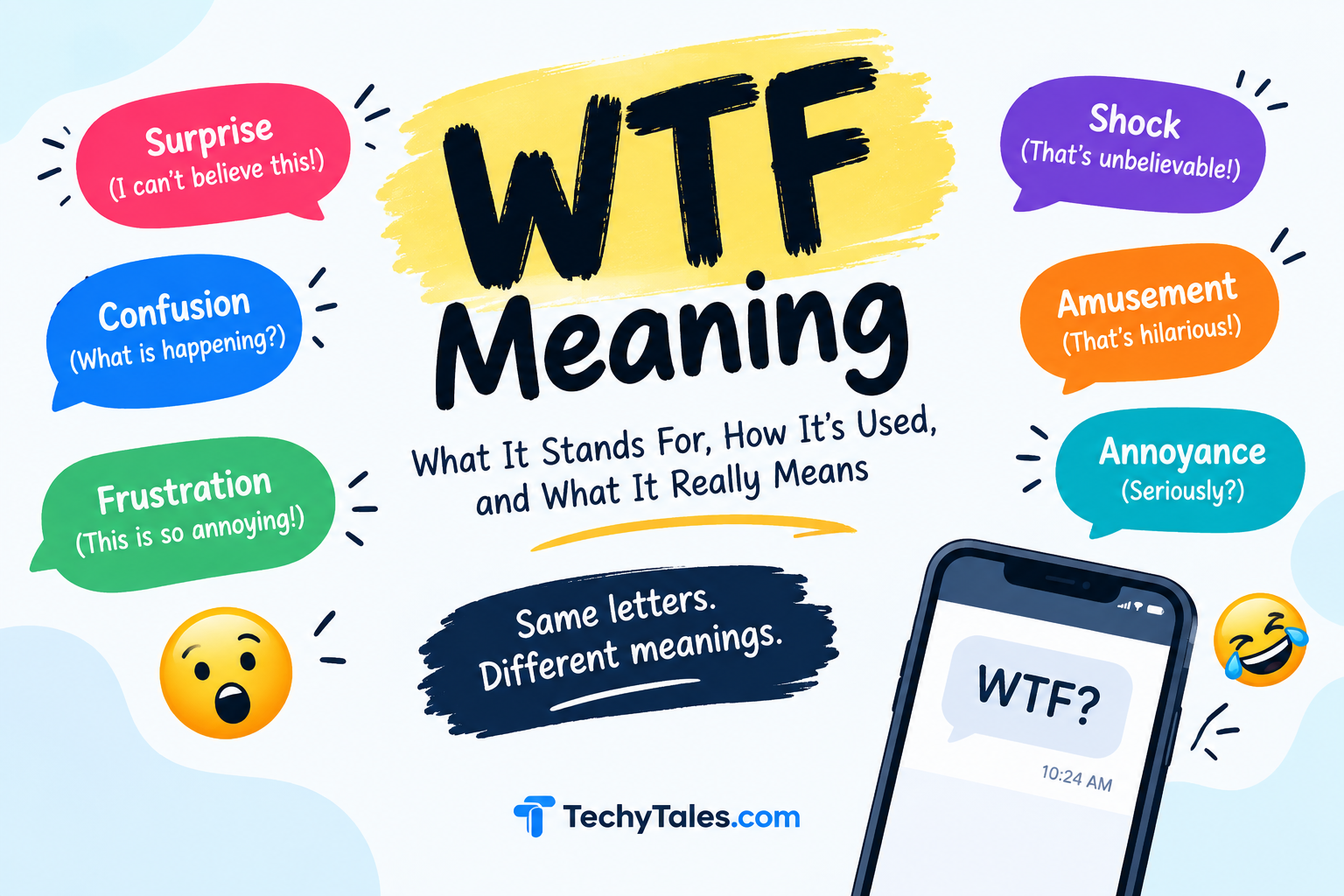

WTF Meaning is What the fuck?, a vulgar slang expression people use in texts, chats, comments, and everyday online conversations when they feel surprised, confused, shocked, frustrated, or unable to believe something. People often search what does wtf mean after seeing WTF in a text message, meme, social media comment, or conversation and want to know whether the person was angry, joking, confused, or simply surprised. The exact meaning depends on the context, punctuation, emojis, and what was said before it, so understanding WTF is about more than knowing what the letters stand for.
What Does WTF Mean?
WTF stands for What the fuck? It is an initialism, meaning the first letters of the words are used to create a shortened expression. In everyday digital communication, it works as a quick emotional reaction rather than a literal question in many situations.
For example:
Friend: I accidentally sent the email to the entire company.
You: WTF
Here, WTF may communicate shock and amusement rather than serious anger.
The expression can also be used inside a sentence:
WTF is going on?
WTF happened?
Why did you do that WTF?
The exact interpretation depends on the surrounding words, the relationship between the people communicating, and the situation.
The Real Meaning Depends on Context
If you are asking what does wtf mean, the dictionary definition gives you the basic answer, but context tells you what the sender actually intends.
WTF can communicate several different reactions:
| Situation | Likely meaning |
| Unexpected news | I cannot believe this |
| Something confusing | What is happening? |
| A frustrating problem | This is really annoying |
| Something shocking | That is unbelievable |
| Something ridiculous | That makes no sense |
| Something funny | That was completely wild |
| Someone behaving strangely | Why are you doing that? |
Consider these two messages:
WTF, you won the lottery?!
WTF, why would you do that?
The first may express excited disbelief. The second can sound annoyed or confrontational.
That is why reading only the three letters is not enough. The surrounding conversation provides much of the meaning.
WTF Reaction Decoder
Small details can change how WTF feels.
WTF?
A short WTF? usually signals surprise or confusion. The sender may simply want an explanation.
WTF?!
Adding an exclamation mark makes the reaction stronger. It can indicate shock, disbelief, excitement, or anger depending on the conversation.
WTF
The laughing emoji can make the expression feel playful. The person may think something is absurd or unexpectedly funny.
WTF
A shocked or embarrassed emoji can suggest genuine surprise or disbelief.
WTF…
The trailing dots can make the message feel confused, disappointed, suspicious, or speechless.
WTF!!!
Multiple exclamation marks usually increase the emotional intensity. Whether that intensity is funny or hostile depends on the context.
Capitalization matters less than people sometimes assume. WTF and wtf generally have the same basic meaning, although uppercase letters can make the reaction look more emphatic.
WTF Meaning in Text Messages
The meaning wtf text messages carry is usually emotional rather than literal. Someone might send WTF after receiving unexpected news, seeing a strange photo, discovering a mistake, or hearing something that does not make sense.
For example:
Person A: I just locked my keys inside the car.
Person B: WTF How did you manage that?
Here, the response sounds teasing and surprised.
Another example:
Person A: The flight was cancelled five minutes before boarding.
Person B: WTF? Are you serious?
This expresses disbelief and frustration.
And:
Person A: My phone just deleted the entire note.
Person B: WTF!!!
This is mainly frustration.
When someone sends only WTF, the message is especially dependent on context. It could mean I am shocked, I am confused, I cannot believe this, or I am annoyed. Look at what happened immediately before the message to understand the intended reaction.
How Is WTF Used Online?
WTF became closely associated with internet communication because short expressions are convenient in chats, forums, comments, and social media. It can appear as a standalone reaction, as part of a sentence, or as a response to a photo, video, post, or unexpected statement. Cambridge specifically identifies text messages and social networking websites as common contexts for WTF.
On social media, someone might comment WTF? when a video contains an unexpected moment. In a group chat, a person might type WTF after hearing surprising news. In gaming chat, it may appear after an unexpected game event or a frustrating mistake.
It is also common for WTF to appear alongside GIFs, memes, punctuation, or emojis. These extra elements can help communicate whether the reaction is intended as funny, shocked, frustrated, or serious.
Because online communication often lacks facial expressions and voice tone, context becomes especially important.
WTF as a Standalone Reaction
When WTF appears by itself, it usually acts like an emotional response.
Imagine a friend sends you a photo showing that they accidentally bought 50 pizzas instead of 5.
You might respond:
WTF
You are probably not demanding a literal explanation. You are reacting to how ridiculous the situation is.
In another conversation, a friend tells you that their flight was cancelled, their luggage disappeared, and their hotel reservation was lost.
WTF?!
Now the same abbreviation communicates genuine disbelief and frustration.
The words have not changed. The situation has.
WTF in Business and Workplace Communication
What does WTF mean in business? It still means What the fuck?, but using it in a workplace can create a very different impression from using it with friends.
WTF is generally considered informal, vulgar, and potentially offensive. Oxford describes it as offensive slang, while Cambridge calls it offensive slang and identifies its use in texts and social networking as an informal context.
For that reason, WTF is usually inappropriate for formal business emails, client communication, job applications, official documents, presentations, or messages to people you do not know well.
Instead of:
WTF happened to the report?
A professional alternative could be:
What happened to the report?
Or:
Can you help me understand what happened with the report?
Among close coworkers who already communicate casually, someone might use WTF in a private conversation. Even then, workplace culture and the relationship between the people involved matter.
The safest distinction is simple: WTF belongs mainly to casual communication, while professional communication usually calls for clearer and less profane wording.
Where Did the Term WTF Come From?
The exact origin of the abbreviation is not completely settled, so it is better not to attach it to one definitive inventor or event.
The underlying phrase What the fuck? appeared in written sources before the internet became widespread. Historical language records also show WTF appearing in early online communication. Wiktionary records a 1985 Usenet example using WTF, while Know Your Meme identifies Usenet as an early online setting for the abbreviation.
During the growth of internet forums, newsgroups, chatrooms, and message boards, abbreviations became useful because people could communicate quickly and sometimes avoid automated word filters. WTF eventually became a familiar piece of internet slang and later spread through texting and social media.
So, while people sometimes describe WTF as an invention of texting or social media, its history is older than modern smartphones and social platforms.
WTF vs WFT
WFT is usually not the same expression as WTF.
WTF follows the first letters of What the fuck. WFT reverses the final two letters, so it does not normally represent the standard slang expression.
If someone writes WFT in a conversation where WTF would make sense, it may simply be a typing mistake.
There are also legitimate contexts where WFT can stand for something else, so context matters. It should not automatically be corrected or interpreted as WTF without looking at the surrounding conversation.
If the message is clearly reacting to something shocking or confusing, a typo is a reasonable possibility.
WTF Compared With Softer Alternatives
WTF is stronger and more vulgar than several expressions that communicate a similar reaction.
| Expression | General tone |
| WTF | Strong, vulgar, highly informal |
| WTH | Milder and more socially acceptable |
| What the heck? | Mild and casual |
| Seriously? | Casual and less offensive |
| What happened? | Neutral |
| What on earth? | Mild surprise or disbelief |
For example, WTF is more intense than Seriously? and much more informal than What happened?
That does not mean WTF always sounds angry. Friends may use it jokingly. The main difference is that WTF carries profanity, which makes it more socially risky.
When Should You Avoid WTF?
Avoid WTF when the setting calls for professional, respectful, or formal language.
That includes:
Job applications and interviews
Customer service messages
Formal business emails
Academic writing
Official documents
Communication with clients or senior professionals
Situations where you are unsure how the other person feels about profanity
With close friends, WTF may be completely normal. With a stranger, customer, manager, teacher, or professional contact, the same expression can come across as rude or aggressive.
Common Examples of WTF
Here are some natural examples that show how the meaning changes with context.
Friend: I forgot my wallet at home again.
You: WTF
This is playful disbelief.
Friend: They cancelled the concert after everyone arrived.
You: WTF? That is ridiculous.
This shows frustration and disbelief.
Coworker: The client changed the entire project at the last minute.
You: WTF?
In a private casual conversation, this may express surprise. In a formal workplace message, a more neutral response would be better.
Someone posts an unbelievable video online.
Comment: WTF?!
Here, the expression may simply mean that the viewer is shocked or confused by what they saw.
FAQs
What does WTF stand for?
WTF stands for What the fuck? It is an offensive slang initialism commonly used to express surprise, confusion, disbelief, frustration, annoyance, or shock.
What does WTF mean in text messages?
In text messages, WTF is usually a strong emotional reaction. Depending on the conversation, it can mean I cannot believe this, What is happening?, That is crazy, or Why did you do that?
Is WTF a bad word?
WTF contains the profanity fuck, so it is generally considered vulgar or offensive slang. It may be acceptable among friends in casual conversation but is not suitable for many formal or professional situations.
What does WTF mean online?
Online, WTF is commonly used as a quick reaction to something surprising, confusing, ridiculous, funny, frustrating, or unbelievable. It appears in chats, comments, social media, forums, memes, and other informal digital communication.
Can WTF be used professionally?
It can appear in casual communication between coworkers, but it is generally better to avoid it in formal workplace communication because it contains profanity and may sound rude or unprofessional.
What does WFT mean?
WFT does not normally mean What the fuck? The standard abbreviation is WTF. If WFT appears in a casual conversation where WTF would make sense, it may be a simple typing error, although WFT can have other meanings in specific contexts.
Conclusion
WTF means What the fuck? and is one of the most recognizable forms of informal internet slang. Its purpose is usually to express a strong reaction, but the exact emotion depends on context.
WTF can communicate surprise, confusion, disbelief, frustration, amusement, or annoyance. A question mark, exclamation mark, emoji, surrounding words, and relationship between the people involved can all change how the message sounds.
The simplest way to interpret WTF is to look beyond the abbreviation itself. Ask what happened immediately before it, who sent it, and what the rest of the conversation suggests. That context usually tells you whether WTF means I am confused, I cannot believe this, that is hilarious, or I am genuinely annoyed.