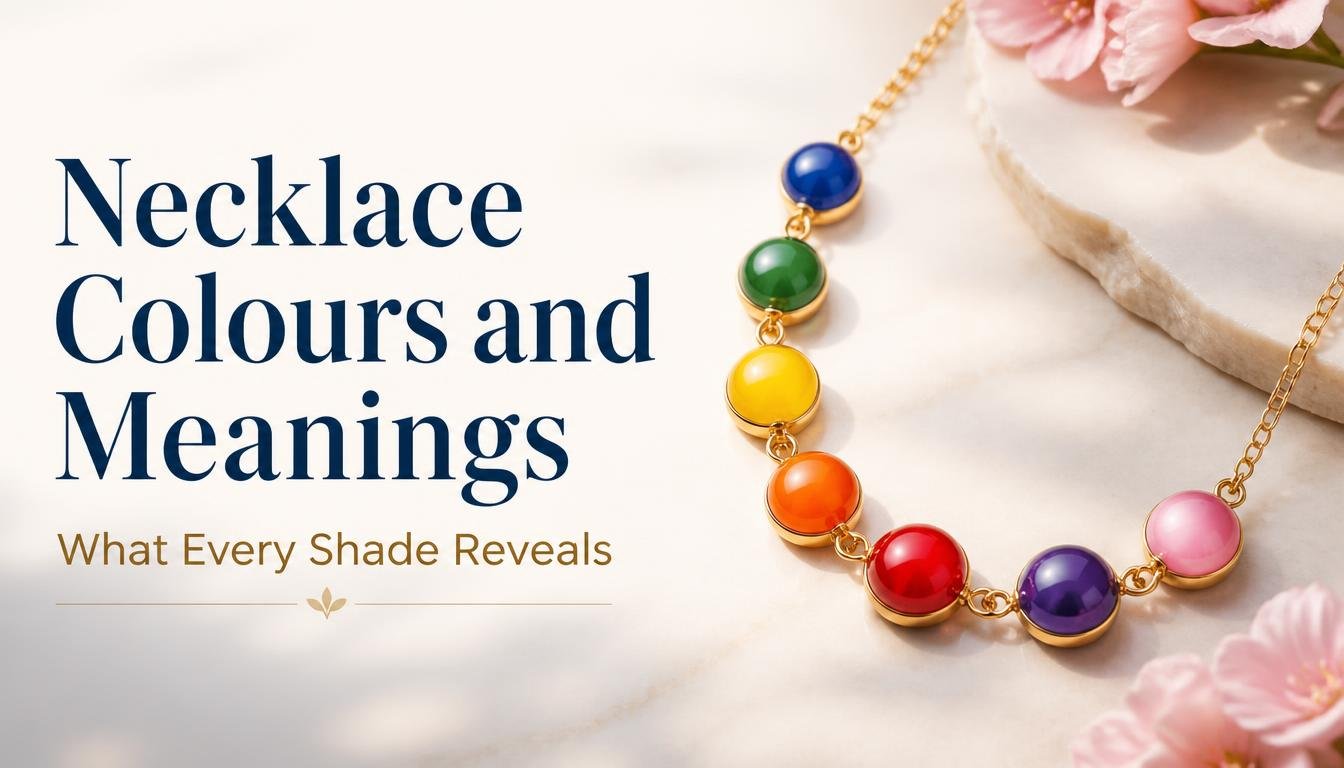

Mood necklace colours and meanings are usually linked to changes in body temperature rather than emotions themselves. The thermochromic material inside the pendant reacts to heat, producing shades that are traditionally associated with feelings such as calmness, excitement, stress, affection, or creativity. Because room temperature, skin temperature, activity, and the necklace’s formulation can all affect the result, the colors are best treated as a fun guide, not a precise emotional test.
Mood Necklace Colours and Meanings at a Glance
Here is a quick reference to the shades most commonly found in mood jewelry:
| Color | Common meaning |
| Black | Cold, stressed, tense |
| Gray | Nervous, uneasy |
| Brown | Restless or anxious |
| Amber | Mixed or unsettled feelings |
| Yellow | Optimistic, thoughtful, creative |
| Green | Calm, balanced, comfortable |
| Teal | Relaxed and peaceful |
| Blue | Calm, happy, sociable |
| Dark blue | Deep relaxation and contentment |
| Purple | Creative, romantic, deeply emotional |
| Pink | Affection, warmth, curiosity |
| Red | Excitement, passion, high energy |
| Orange | Enthusiasm, playfulness, adventure |
The exact palette varies between manufacturers, so your necklace may not display every shade or may assign a slightly different meaning to the same color.
How Does a Mood Necklace Work?
A mood necklace uses a thermochromic material that changes its appearance as temperature changes. Many designs use liquid crystals that alter the wavelengths of light they reflect when warmed or cooled. The pendant therefore responds to heat at the skin and surrounding environment.
That distinction matters: a mood necklace does not directly measure happiness, anxiety, love, or anger. It detects temperature. Emotional states can influence circulation and skin temperature, but outside conditions can influence them too. A cold room, warm shower, exercise, sunlight, or simply holding the pendant can change its color.
This is why two people can experience the same color while feeling completely different emotions. The traditional mood meanings are interpretations layered onto a real temperature-sensitive response.
What Does Black Mean on a Mood Necklace?
Black is commonly associated with stress, tension, fear, or feeling overwhelmed. However, black does not automatically mean you are in a bad mood. A cool environment is one of the simplest reasons a pendant can become dark.
If your necklace stays black, check the temperature around you before interpreting the color emotionally. Air conditioning, cold weather, or limited contact with warm skin can keep the thermochromic material in a darker state.
What Do Gray and Brown Mean?
Gray is often linked with nervousness, uneasiness, or anxiety, while brown is commonly associated with restlessness or anticipation. These shades generally sit toward the cooler end of traditional mood charts.
They can also appear because your skin or surroundings are cool. For that reason, treat the emotional meaning as a possibility rather than a diagnosis.
What Do Amber and Yellow Mean?
Amber or yellow-brown shades are often interpreted as mixed, unsettled, or changing emotions. Yellow is usually associated with optimism, creativity, thoughtfulness, or positive energy.
A yellow reading can be especially interesting when the pendant is transitioning between colors. Instead of seeing it as one fixed emotional label, consider it a snapshot of your physical temperature at that moment.
What Does Green Mean on a Mood Necklace?
Green is commonly associated with calmness, balance, comfort, and contentment. It is often considered the neutral or comfortable zone on traditional mood charts.
If your necklace turns green while you are sitting comfortably, that may fit the classic interpretation. Still, the color primarily tells you that the thermochromic material has reached a particular temperature range. It does not prove that you are emotionally balanced.
What Do Teal and Blue Mean?
Teal is commonly connected with peacefulness, relaxation, and a comfortable state. Blue is often associated with calmness, happiness, serenity, and sociability.
Dark blue usually represents an even warmer and more relaxed interpretation, such as deep calm, contentment, or emotional security. Because blue shades can differ considerably between products, your necklace’s included color chart should take priority when it provides one.
What Do Purple, Pink, Red, and Orange Mean?
Purple is traditionally associated with creativity, romance, mystery, imagination, or intense emotion. Pink often suggests affection, warmth, curiosity, or attraction.
Red usually represents high energy, excitement, passion, or strong emotional activation. But physical activity can produce the same result. A workout, hot shower, or warm surroundings may raise the pendant’s temperature without indicating anger or romance.
Orange is commonly interpreted as enthusiasm, playfulness, confidence, or a desire to explore. It often appears somewhere between warmer yellow and red tones, although the exact transition depends on the thermochromic material.
Why Does My Mood Necklace Show the “Wrong” Color?
The necklace may not actually be wrong. Its reading can be affected by several physical factors:
- Room temperature
- Outdoor weather
- Air conditioning or heating
- Skin temperature
- Exercise
- Hot or cold drinks
- Direct sunlight
- How closely the pendant touches your skin
- Differences between manufacturers
For example, you could feel completely relaxed while sitting in a cold office and see black or gray. You could also feel stressed after exercising and see red because your skin is warm. The color reflects the physical conditions around the thermochromic material, so context matters.
Are Mood Necklace Color Meanings Scientifically Accurate?
The temperature response is real, but the emotional labels are not precise scientific measurements. A thermochromic pendant can respond reliably to changes in temperature while still being unable to identify the reason for that temperature change.
That means a blue necklace cannot confirm that you are happy, and a black necklace cannot confirm that you are stressed. The traditional meanings are best understood as playful interpretations. If you want to know how you actually feel, your own emotional awareness is more useful than a jewelry color.
How Can You Get a More Consistent Reading?
Wear the pendant against your skin for a few minutes and observe it under similar conditions. Avoid judging the result immediately after coming in from extreme heat or cold. Also compare the color with the chart supplied with your necklace because different products can use different thermochromic ranges.
If the pendant suddenly changes after you move between indoor and outdoor temperatures, that is normal. If it remains completely dark or stops responding even when gently warmed by your hand, the thermochromic element may have been damaged or may have reached the end of its useful life.
Mood Necklace vs. Mood Ring: Is There a Difference?
Both pieces generally rely on the same basic idea: a thermochromic material responds to temperature and displays a color. The biggest practical difference is where the jewelry sits.
A ring is in direct contact with a finger, while a necklace sits against the neck or upper chest. Because those areas can have different skin temperatures and exposure to the environment, the same person may see different shades from each item at the same time.
Neither should be treated as a medical or psychological measuring device. They are primarily interactive jewelry designed to make temperature changes visible.
How Should You Read a Mood Necklace Color?
The most useful approach is to combine the color with the situation instead of reading it in isolation. Check whether the pendant has recently been exposed to a different temperature. If the color shifts while you are sitting quietly, compare it with the traditional emotional interpretation for fun. Repeated patterns can be interesting, but they should not be treated as proof that one emotion always produces one shade.
Mood jewelry is designed to be interactive. Its appeal comes from watching a color change and deciding what that change might mean. The experience is more enjoyable when you leave room for curiosity rather than expecting the necklace to read your mind.
Frequently Asked Questions
What is the most common mood necklace color?
Green, blue, and black are among the most commonly discussed colors in traditional mood necklace charts. Green is usually linked with balance, blue with calmness, and black with cold or stress.
What does a blue mood necklace mean?
Blue is traditionally associated with calmness, happiness, relaxation, and sociability. The actual color change reflects temperature, so the shade should not be treated as proof of a particular emotion.
What does purple mean on a mood necklace?
Purple is commonly linked with creativity, romance, imagination, and deep emotion. Its exact interpretation varies because different necklaces use different thermochromic formulations.
Why does my mood necklace stay black?
Cold surroundings are a common reason. If the pendant remains black even after gentle warming, the thermochromic material may be damaged. Moisture, heat exposure, age, or product-specific limitations can also affect performance.
Can a mood necklace really detect emotions?
No. It detects temperature, not emotions directly. Emotional changes can affect body temperature, but environmental conditions and physical activity can create similar temperature changes.
The Bottom Line
Mood necklace colours and meanings are most useful when you see them as a fun interpretation of a real temperature-sensitive reaction. Green may suggest calm, blue may suggest relaxation, purple may suggest creativity, and red may suggest excitement, but none of these colors can tell you exactly what you feel.
For the best experience, use the color chart made for your specific necklace, consider the surrounding temperature, and treat each shade as a conversation starter rather than a scientific verdict.