


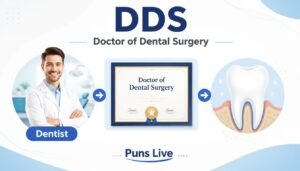
DDS Meaning of Doctor of Dental Surgery, a degree awarded to licensed dentists after completing dental school. It’s one of two official dental degrees used in the United States, alongside DMD (Doctor of Dental Medicine). Both degrees mean the exact same thing in terms of training, licensing, and the care you receive the letters simply depend on which university the dentist attended.
If you’ve seen “DDS” after your dentist’s name on a business card, office sign, or insurance paperwork, this article explains what the credential actually represents, how it compares to DMD, what training goes into earning it, and what it means for the quality of care you can expect.
What Does DDS Stand For?
DDS stands for Doctor of Dental Surgery. It’s the professional degree earned by dentists who complete an accredited dental education program, typically after finishing a four-year undergraduate degree.
Despite the name, “dental surgery” doesn’t mean the dentist only performs surgical procedures. The term reflects the historical naming of dental degrees in the 1800s, when dentistry and surgery were closely linked fields. A DDS is a general dentist qualified to diagnose oral health conditions, perform cleanings and fillings, extract teeth, fit crowns and dentures, and refer patients to specialists when needed — the same scope of practice as a dentist holding a DMD.
DDS vs. DMD: What’s the Difference?
There is no practical difference between a DDS and a DMD. Both degrees require the same coursework, clinical hours, and national board exams. The choice of title comes down to the dental school, not the dentist’s qualifications.
Harvard School of Dental Medicine was the first to award the DMD degree in 1867, using “dental medicine” to align dentistry more closely with the medical field. Most other schools kept the original DDS title. Today, roughly two-thirds of U.S. dental schools award DDS degrees, while the remainder award DMD degrees.
| Factor | DDS | DMD |
| Full name | Doctor of Dental Surgery | Doctor of Dental Medicine |
| Coursework required | Same accredited curriculum | Same accredited curriculum |
| Licensing exam | Same national and state boards | Same national and state boards |
| Scope of practice | General dentistry | General dentistry |
| Determined by | Dental school | Dental school |
Because state dental boards recognize both degrees as equivalent, a dentist cannot legally practice with more or less authority based on which title they hold. When choosing a dentist, the degree letters matter far less than the dentist’s experience, patient reviews, and any additional certifications in specialties like orthodontics or oral surgery.
Some patients assume DMD sounds more “medical” and therefore more advanced, but this is a misconception. Dental schools choose one title and apply it to every graduate regardless of that person’s individual grades, clinical skill, or specialty interests. A brand-new DDS graduate and a 20-year veteran DMD have gone through comparable accredited training; the letters say nothing about experience level.
How Do You Become a DDS?
Earning a DDS typically takes eight years of education after high school, followed by state licensing.
Undergraduate degree (4 years). Most dental schools require a bachelor’s degree, often in biology, chemistry, or a related science, along with prerequisite coursework in subjects like organic chemistry and anatomy.
Dental Admission Test (DAT). Applicants take this standardized exam, which covers science knowledge, perceptual ability, and reading comprehension, as part of the dental school application process.
Dental school (4 years). The first two years focus on classroom and lab-based science courses. The final two years shift to supervised clinical work, treating real patients under faculty guidance.
National board exams. Students must pass the Integrated National Board Dental Examination (INBDE), which tests clinical knowledge and decision-making.
State licensure. After graduation, dentists must obtain a license in the state where they plan to practice, which usually involves a clinical licensing exam and background check.
Some DDS graduates continue into specialty residencies in fields such as orthodontics, periodontics, endodontics, oral surgery, or pediatric dentistry which add two to six additional years of training.
Dental school accreditation matters throughout this process. In the U.S., programs must be accredited by the Commission on Dental Accreditation (CODA) for graduates to sit for licensing exams. This accreditation is what makes a DDS from one school equivalent to a DDS or DMD from another, regardless of location or program size.
What Can a DDS Dentist Do?
A general dentist with a DDS is trained to handle the full range of routine and restorative oral health care, including:
Diagnosing tooth decay, gum disease, and other oral health issues
Performing cleanings, exams, and X-rays
Placing fillings, crowns, and bridges
Extracting teeth, including some wisdom teeth
Fitting dentures, retainers, and night guards
Treating early-stage gum disease
Providing referrals to specialists for complex cases like root canals, implants, or jaw surgery
For more complex procedures, a DDS may either handle the treatment directly, depending on their training and comfort level, or refer the patient to a specialist who has completed additional residency training in that area.
Many general dentists with a DDS also handle cosmetic requests such as teeth whitening, bonding, and veneers, though the depth of cosmetic training varies by dentist rather than by degree type. If cosmetic work is a priority, it’s worth asking about a specific dentist’s case history and before-and-after examples rather than assuming the DDS title guarantees a certain aesthetic skill set.
Is a DDS the Same as a Regular Dentist?
Yes. “DDS” isn’t a specialty or an advanced credential — it’s simply the standard degree that qualifies someone to practice as a general dentist. Every state-licensed general dentist in the U.S. holds either a DDS or a DMD; there is no third, higher-ranking dental degree for general practice.
Specialists build on top of this base degree. An orthodontist, oral surgeon, or endodontist first earns a DDS or DMD, then completes a separate residency and often adds letters like DDS, MS or DMD, FAGD to reflect that additional training.
You may also see other credential letters near a dentist’s name, such as FAGD (Fellow of the Academy of General Dentistry) or MAGD (Master of the Academy of General Dentistry). These reflect continuing education achievements on top of the base DDS or DMD degree, rather than a different level of licensure to practice general dentistry.
What to Look for Beyond the DDS Title
Since DDS and DMD carry identical legal weight, other factors matter more when evaluating a dentist:
State license status. Confirm the dentist is currently licensed in your state through your state dental board’s public lookup tool.
Years of experience and the specific procedures they perform regularly.
Continuing education and membership in professional organizations such as the American Dental Association (ADA).
Patient reviews that speak to comfort, communication, and outcomes.
Insurance network status, if cost and coverage are a priority.
Office technology and sterilization practices, particularly for patients with specific health concerns.
A DDS credential confirms baseline qualification and legal standing to practice dentistry. It doesn’t, by itself, indicate a dentist’s specific skill level, bedside manner, or fit for your particular needs — those come from research beyond the letters after their name.
If you’re comparing dentists for a specific procedure, it also helps to ask directly how often they perform that particular treatment. A general dentist who regularly places crowns or handles Invisalign cases may have more hands-on comfort with that procedure than one who does it only occasionally, even though both hold the same DDS credential.
Frequently Asked Questions
Is DDS higher than DMD?
No. DDS and DMD represent identical levels of education, training, and licensing. Neither degree ranks above the other.
Can a DDS perform root canals or extractions?
Yes, general dentists with a DDS are trained to perform many extractions and, in some cases, root canals. More complex cases are often referred to an endodontist or oral surgeon.
Why do some dentists use DDS and others use DMD?
The title depends entirely on which dental school they attended, not their skill or scope of practice. Each school chooses one degree name to award to all its graduates.
Do I need to choose between a DDS and DMD dentist?
No. Since the degrees are equivalent, choosing a dentist should be based on experience, reviews, specialty training, and personal comfort rather than the specific letters after their name.
Is a DDS a doctor?
Yes, in the sense that DDS is a professional doctoral degree, similar to a JD for lawyers or an MD for physicians. Dentists are typically addressed as “doctor” in clinical settings, though the degree is distinct from a medical doctor’s MD.
How long does it take to become a DDS?
It generally takes eight years: four years of undergraduate study followed by four years of dental school, plus licensing exams before beginning practice.
The Bottom Line
DDS means Doctor of Dental Surgery, the degree most U.S. general dentists hold after completing dental school and passing licensing exams. It carries the same training, legal authority, and scope of practice as a DMD the only real difference is which term a dentist’s school chose to use. When picking a dentist, experience, licensing status, and patient feedback matter far more than whether their title reads DDS or DMD.